

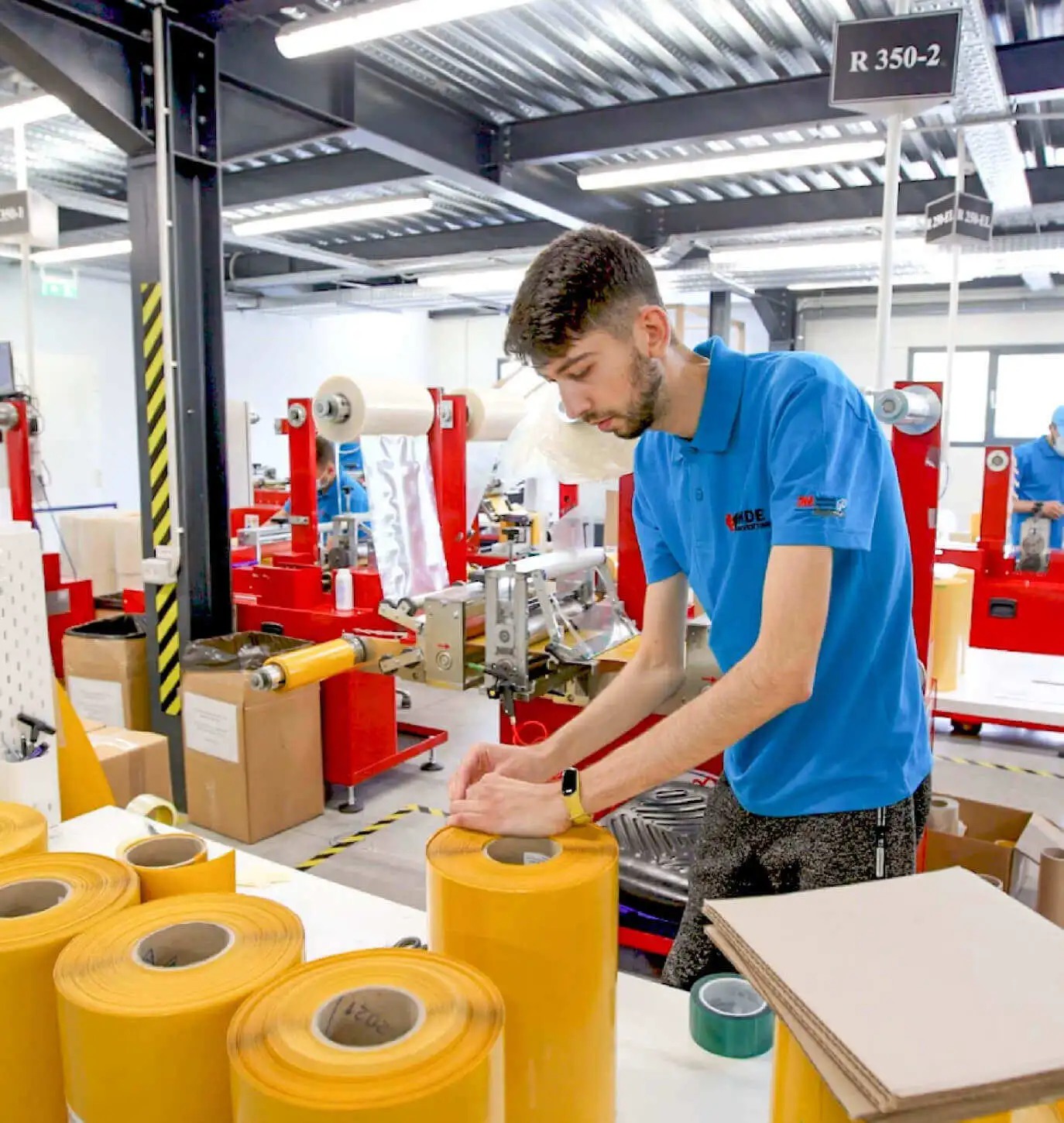
Products are becoming more compact, production cycles are faster, and customer expectations continue to rise. At the same time, manufacturers are expected to improve quality, reduce waste, control costs, and remain flexible. These pressures affect nearly every part of a company.
Product development teams need to create better solutions in less time. Production departments must maintain efficiency while handling increasing complexity. In many cases, solving these challenges doesn’t depend on one major change, but on a series of smart decisions. One smart decision is working with professional converters who can provide customized solutions like a car fascia or other adhesive innovations.
Companies that address these challenges strategically often gain a clear advantage. They can do this with the help of specialists who have technical expertise and access to modern materials and technologies. They can improve performance while keeping operations stable over time.
Understanding the real challenge before choosing a solution
Certain industrial problems are treated as material issues or production issues, but they can also be more complex. Sometimes, questions like what is Thinsulate or what’s the best material for electric insulation put manufacturers in difficulty. Therefore, it’s not only a matter of obvious issues, but also a matter of expertise.
A bonding failure may appear to be caused by the adhesive itself, when the real problem is poor surface preparation. A slow production step may seem like a labor problem, while the actual cause is a part that was never designed for easy installation. This is why the first step should be understanding the real source of inefficiency.
When it comes to adhesive solutions, a 3M Preferred Converter often begins by analyzing:
- External factors like humidity, chemicals, or dust
- Mechanical stresses like vibration, compression, or peel
- Which materials interact with each other
- How the final component should work
Using advanced materials and better component design
Once experts find out what the actual challenge is, the next step is choosing the right materials and shaping the component design. Converters work with advanced materials that have specific properties. Some adhesive parts require a single type of material, while others require multiple types to ensure multiple functions.
Especially when assemblies are compact, multifunctional, lightweight, or exposed to demanding conditions, standard materials aren’t the best answer. Modern industrial solutions often rely on technical foams, films, and adhesive tapes that match the needs of a specific project.
If necessary, a single component can provide:
- Thermal or electrical insulation
- Vibration damping and noise reduction
- Protection against moisture and UV radiation
Good component design is just as crucial as material selection. A well-designed part is easy to apply, consistent in performance, and adapted to the existing processes. In many cases, a simple design leads to fewer errors and lower production costs.
Making improvements to work in real operating conditions
In the industrial world, production is not an easy process and it requires a lot of precision and alignment. Even a technically strong solution must work effectively on the production floor. It should be easy to apply, consistent in quality, and compatible with the existing equipment.
When working on a project, converters ensure that the component they create performs well and fits naturally into the daily workflow of the factory. Here’s how they do that and what they focus on:
| Focus area | Why it matters |
| Easy handling and application | Components that are simple to position and install help reduce assembly time and operator effort |
| Consistent dimensions and quality | Uniform parts improve repeatability and reduce the risk of performance issues |
| Reduced process variability | Ready-to-use parts help minimize manual adjustments and improve production consistency |
| Validation through testing | Trials in real conditions confirm that the component performs as expected before serial production |
Solving problems through smart decisions
In the modern industrial world, problems rarely have simple answers. They usually require a combination of technical understanding and practical thinking. Companies that take time to understand the real issue and invest in suitable solutions are better positioned to improve operational efficiency.
In many cases, the strongest competitive advantage comes from continuous improvement rather than a huge transformation. Small, well-planned improvements made by professional converters can create meaningful results in the long run. These specialists help manufacturers build smarter systems that prevent problems rather than react to them.


