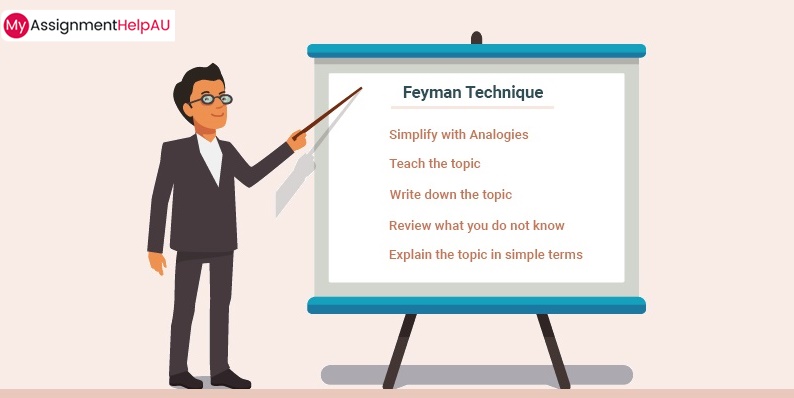
Created by Richard Feynman, a well-known physicist, The Feynman Technique is a four-step approach for learning, understanding, and remembering.
Do you find it challenging to grasp a concept? To make matters worse, you can’t recall anything you’ve read.
“This seems too wonderful to be true,” you might think. But here’s the thing: here’s the deal. No ordinary person came up with the approach.” says Van, a freelancer providing service in online My Assignment Help.
- What is the Feynman Technique, and how does it work?
The Feynman approach is a manner of learning that may benefit anyone in a circumstance like the ones listed below:
- A student studying for an exam or certification
- A business professional that needs to grasp a concept
- A baker who needs to recall a cheesecake recipe
- A mechanic who needs to recall how a vehicle works
In short, the Feynman approach is one of the most helpful self-learning strategies available to everyone.
The procedure can assist you in resolving any of three typical learning issues:
- Not being able to grasp the topic well enough
- Forgetting what you’ve learned
- Learning ineffectively
- How to Put Feynman’s Technique to Use
The Feynman method may be applied in four phases. These procedures are not only simple to comprehend, but they are also simple to carry out. This integration applies to any subject of study or area of competence.
Step 1: Make a list of the topics you want to research.
Write the topic you wish to study on the top of a sheet of paper as the first step.
If you haven’t learned the material yet, go ahead and study in your way. When reading for the first time, the approach does not give any particular techniques for learning information.
If you’ve already studied the subject, make a list of all you know about it. You don’t need to jot down every detail. On the issue, bullet points will serve.
Before practising your essay writing, you have to select topics first, and Online Essay Writing Service helps you. Similarly, Feynman’s technique also says you to choose the topic of research first.
Step 2: Introduce the issue to your students.
Consider educating a pupil about what you’ve learned. Assume you have an invisible pupil sitting in front of you with a notebook and a pen, ready for your teachings. Act as a competent teacher and instruct your virtual student.
You may also instruct yourself by looking in the mirror. Observing yourself teach will boost your confidence and make you a better presenter.
Choose the instructional method that best matches your needs. As long as you teach, any approach will work.
You will become aware of your knowledge gaps as you teach the topic. When you read the material, your mind fools you into thinking you know everything there is to know about the subject. When teaching, you may run into specific difficulties with some aspects of the issue. Please note this when this happens since you are stumbling over something you don’t understand well enough.
You are the easiest person to deceive in terms of your thinking.
Step 3: Go over what you don’t understand.
Examine all of the gaps in your knowledge of the issue that you discovered in the previous stage. Return to the study materials and re-read the sections you don’t understand to brush up on your knowledge.
Do not attempt to go through the content as quickly as possible. You’ll only fill the holes halfway, leaving a smaller gap that has to be filled. When you teach the following time, you’ll discover how little you know.
Make a concerted effort to comprehend as much as possible. You may still require a second or third revision, but the number of times you return to revise will be reduced.
Knowing the gap will aid you in assembling the missing parts into a single jigsaw puzzle, after examining what you missed while teaching, your understanding of the subject will no longer be as fragile as before.
Step 4: Teach a child about the subject.
Finally, you must be able to describe the issue in the most straightforward manner possible. Assuming you’re educating a child is the most excellent approach to accomplish simplicity. You are obliged to break down the material using primary language since the small one lacks sufficient understanding in all areas.
Use primary language, real-life examples, simple illustrations, or realistic analogies.
Explain a subject in pure vanilla taste if you want to have a good understanding of it. You have a decent grasp of the subject if you can. If you can’t, go back to your book.
Even if the kid doesn’t exist in reality, presuming you’re educating a child is the most excellent method to self-teach. Here are some other options for instructing a child:
- Teaching the topic to yourself in front of a mirror
- Finding a friend or spouse who is eager to listen
- Going on a video call with a friend who has the time and patience to listen
Conclusion
Learning necessitates the use of one’s intellect. For the time being, understanding the brain is quite restricted. Reading a book for hours on end is not the best way to aid your brain’s comprehension. Because the brain is made up of billions of neurons, it does not think linearly.
One can take the help of online essay help and online essay writing service provider to understand the concept if they are confused.
Multiple neurons fire into action to make every action, decision, and idea conceivable. As a result, you are engaging a more significant section of your brain in the act of learning by educating, reviewing, and explaining in simple words. The more inventive you are with your knowledge, the more you will comprehend and remember.
The Feynman method is your solution if you’ve ever wondered how to learn something complicated quickly.