

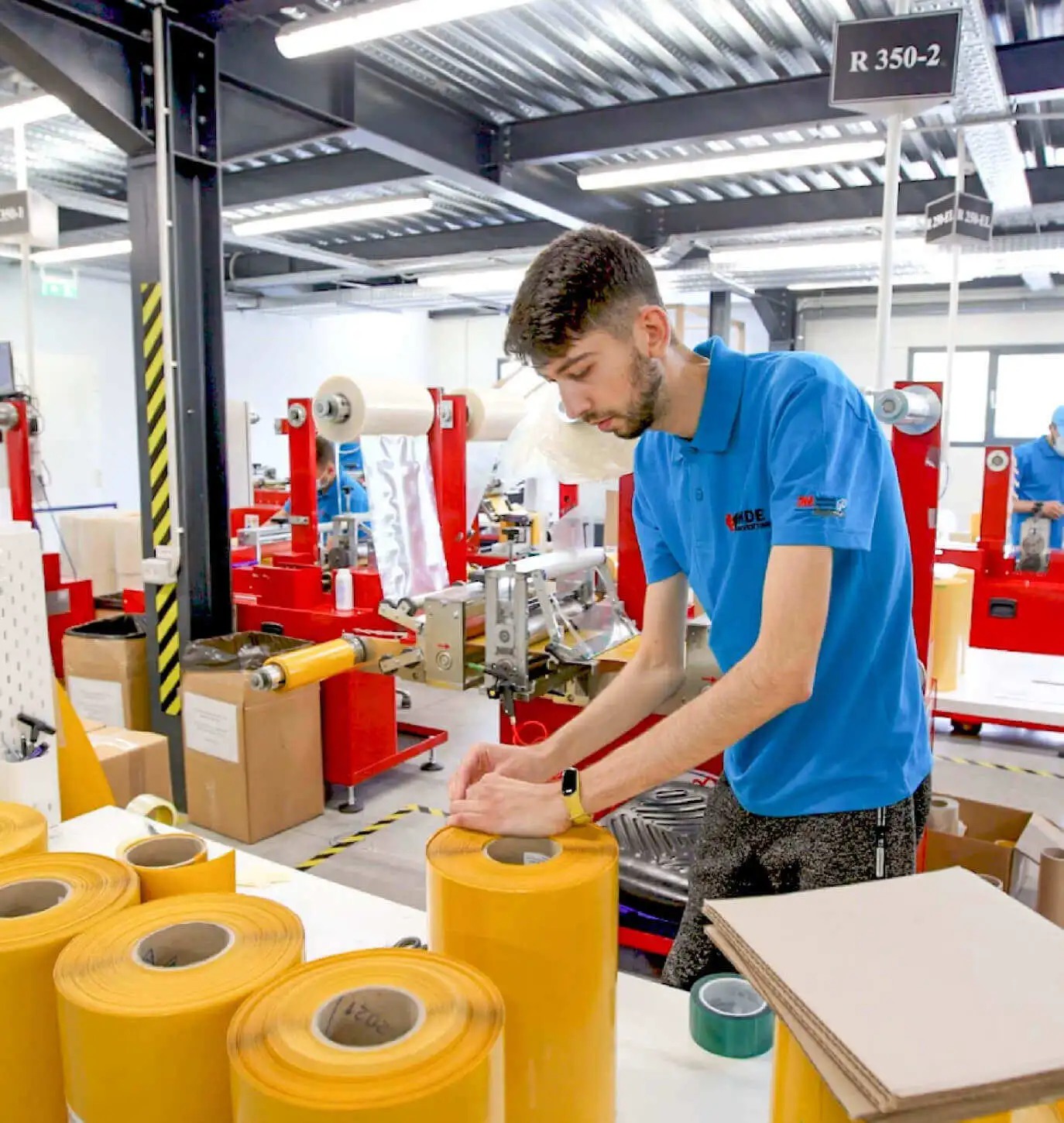
Industrial requirements continue to change from one year to another, with products becoming more compact and production lines faster. At the same time, manufacturers must maintain high-quality standards and stable processes. These changes create new technical challenges for companies across multiple industries.
Modern applications often combine different materials, strict tolerances, and limited installation space. In many cases, standard components are no longer enough to support these requirements. Companies need solutions adapted to the actual conditions of use and to the way products are assembled.
Through adhesive material converting, components can be developed according to specific technical and operational requirements. Their geometry, thickness, and functional properties can all be adapted to the application, whether it’s about creating a car fascia or another type of part. These solutions are important not only for product integration, but also for production efficiency and long-term reliability.
Technical challenges are becoming more complex
Manufacturing processes today involve more than simple assembly operations. Engineers must consider how products behave during production and also after they are used in real conditions. They must evaluate various aspects such as vibration, movement, and temperature changes.
In many industries, products are expected to become lighter and more compact without affecting reliability. This creates additional pressure on production and engineering teams. Therefore, working with a professional converter can be a good decision. These experts have relevant knowledge regarding different topics such as Thinsulate definition. This helps them create components that fit inside restricted spaces while still supporting multiple functions.
Some common technical challenges include:
- Maintaining stable contact between different surfaces
- Managing vibration or repetitive movement
- Integrating components into automated production
- Controlling dimensional variation between parts
- Protecting sensitive areas from dust or moisture
These requirements may vary significantly from one application to another. Because of this, manufacturers often need solutions adapted specifically to the conditions of the project. Standard formats may not always provide the flexibility or compatibility required in complex assemblies, which demonstrates the value of a custom solution developed by a 3M Preferred Converter.
Advanced converting processes allow greater flexibility
Modern technologies allow converters to develop components adapted to specific production and assembly requirements. This is important because industrial applications rarely have identical conditions or specifications. Different products require different geometries, thicknesses, and handling characteristics.
In some cases, components must support automated assembly. In others, they must maintain stable contact between surfaces exposed to movement or vibration. Advanced converting processes help specialists adapt components more precisely to these requirements. The selected process depends on the application, the material, and the expected role of the component.
Here’re some processes converters frequently use:
| Converting process | Purpose |
| Die cutting | Creating precise shapes and dimensions |
| Laminating | Combining multiple layers into a functional structure |
| Slitting | Preparing materials for specific width requirements |
| Kiss cutting | Supporting easier handling and application |
| Rewinding | Improving material processing and storage efficiency |
Modern components often need to support product optimization
Today, technical components are expected to support more than a single function. In many industrial applications, the same part may contribute to sealing, vibration damping, spacing, insulation, or surface protection at the same time. This is one of the reasons why advanced technical solutions have become increasingly valuable in manufacturing.
Here’s what converted adhesive components may help support:
- Cleaner integration inside compact assemblies
- Reduction of unnecessary fixing elements
- Vibration damping between parts
- More stable positioning during assembly
- Compensation for small surface differences
- Simplified handling during production
The role of these elements extends beyond basic assembly. Their configuration may influence production efficiency, assembly speed, and even the long-term behavior of the final product. In many cases, manufacturers also need components that can adapt to future product changes or evolving production requirements. Because of this, flexibility and compatibility have become very important during the development stage.
Advanced solutions help companies adapt more easily
Industrial manufacturing continues to evolve as products become more advanced and production expectations increase. Companies often need technical solutions that can support both current requirements and future development plans. Through adhesive material converting, manufacturers can get solutions adapted to specific products, operating conditions, and assembly processes.
As technical challenges continue to evolve, advanced solutions will remain important for industries that want to maintain efficiency, precision, and long-term production stability. They also allow manufacturers to better respond to market expectations and successfully meet customer demands.


